
Introduction
What is the Cosmic Microwave Background? The Cosmic Microwave Background (CMB) is one of the earliest and most crucial clues scientists have found regarding the universe. It is a glow that permeates the sky from every direction and represents the oldest light we can directly observe.
But what exactly is the Cosmic Microwave Background? Where did it come from? Why is it so cold? And what can it tell us about the universe and its true origins? In this chapter, we will explore these questions, answer them, and explain the CMB in simple terms.
Table of Contents
What Is the Cosmic Microwave Background?
What is the Cosmic Microwave Background? The Cosmic Microwave Background (CMB) consists of microwave radiation left over from the early universe. Scientists consider it the oldest light we can observe today.
The CMB originated when the universe was only 380,000 years old. Before that time, the universe was extremely hot and dense. Matter existed primarily as hot plasma, consisting of free electrons and atomic nuclei.
Because free electrons constantly scattered photons, light could not travel easily through the universe. Simply put, the early universe resembled a dense cosmic fog.
As the universe expanded, it cooled down. Eventually, electrons combined with atomic nuclei to form atoms. This process allowed light to travel more freely.
This ancient light has been travelling through the expanding universe ever since. As space expanded, the light’s wavelength stretched. Today, we perceive that ancient glow primarily as microwave radiation.
According to NASA, the CMB is the oldest observable light, dating back to approximately 380,000 years after the Big Bang.
This makes the CMB incredibly valuable; when scientists study it, they are essentially examining an image of the universe in its infancy.
For those new to cosmology, the CMB can be understood as a snapshot of the universe during its childhood.
To learn more about the cosmos, read our comprehensive guide: What is the universe?
When Was the CMB Created?
What is the Cosmic Microwave Background (CMB)? The CMB dates back to approximately 380,000 years after the Big Bang.
Although this might seem like a long time, compared to the universe’s current age (about 13.8 billion years), it represents the universe’s early stages.
After the Big Bang, the universe was:
- Extremely hot
- Extremely dense
- Filled with plasma
- Teeming with photons
- Filled with free electrons
- Opaque to light (light could not pass through it)
At that time, the stars and galaxies we see today did not exist. There were no familiar galaxies like the Milky Way, nor were there any planets, solar systems, or modern cosmic structures.
Instead, the universe was a rapidly expanding mixture of particles and radiation.
As the universe expanded, the temperature dropped. Eventually, electrons were able to combine with protons and other nuclei to form neutral atoms. With fewer free electrons available to scatter photons, light was finally able to travel over long distances.
This is the light we observe today as the CMB.
NASA’s cosmology overview dates this transition to about 380,000 years after the Big Bang and explains that the universe became transparent once electrons became bound within atoms.
What Happened Before the CMB?
What is the Cosmic Microwave Background? Once we have the answer to this question, the next thought that naturally arises is: what existed before the CMB formed?
Before the CMB formed, the universe was extremely hot and dense. Light existed, but photons could not travel very far because they kept colliding with charged particles.
Think of it this way: imagine shining a flashlight through very dense fog—the beam of light wouldn’t travel very far in a straight line.
The early universe behaved in much the same way.
The Universe Was Once Opaque
Before the CMB emerged, the universe was filled with hot plasma.
Electrons interacted strongly with photons, scattering them repeatedly in all directions. Consequently, the universe was opaque.
This means that ordinary light could not provide us with a direct view of those early times.
Therefore, the CMB acts as a sort of cosmic boundary, offering us the most direct view of the universe’s earliest stages.
Recombination and the First Atoms
When the temperature of the universe dropped to a few thousand Kelvin, electrons and protons were able to combine to form neutral hydrogen atoms.
This period is commonly referred to as “recombination.”
This name can be misleading because, in the early universe, electrons and protons were joining together for the first time, rather than recombining after forming atoms.
Once a vast number of electrons became bound within atoms, photons were able to travel vast distances.
The universe had become transparent.
Those photons continued to travel for billions of years, and we now detect them as the Cosmic Microwave Background.
Why Is the CMB Microwave Radiation?
What is the Cosmic Microwave Background? The Cosmic Microwave Background did not originate as cold microwave radiation.
When the CMB photons were released, the universe was much hotter than it is today.
We detect them as microwaves because the universe is expanding.
As space expanded, the wavelengths of the photons stretched; this stretching is known as cosmological redshift.
Longer wavelengths correspond to lower energy. Over billions of years, the energy of the CMB photons decreased as their wavelengths stretched due to the universe’s expansion.
According to NASA, the expansion of space stretched the CMB wavelengths by a factor of approximately 1,100, shifting them into the microwave region of the electromagnetic spectrum.
In summary, the process looks like this:
Early universe → Hot radiation → Expansion of space → Stretched wavelengths → Present-day microwave radiation.
That’s why the CMB is called microwave radiation.
“The cosmic microwave background is just one part of the story. To get the full picture of everything else hiding out there in the universe, check out our deep dive into What is Space Made Of?”
How Hot Is the CMB Today?
What is the Cosmic Microwave Background?
The CMB is extremely cold. Its average temperature is approximately 2.75 Kelvin, which is roughly equivalent to -270.4°C. This is just a few degrees above absolute zero.
According to NASA’s COBE mission, the CMB spectrum closely matches that of a perfect blackbody at approximately 2.725 K.
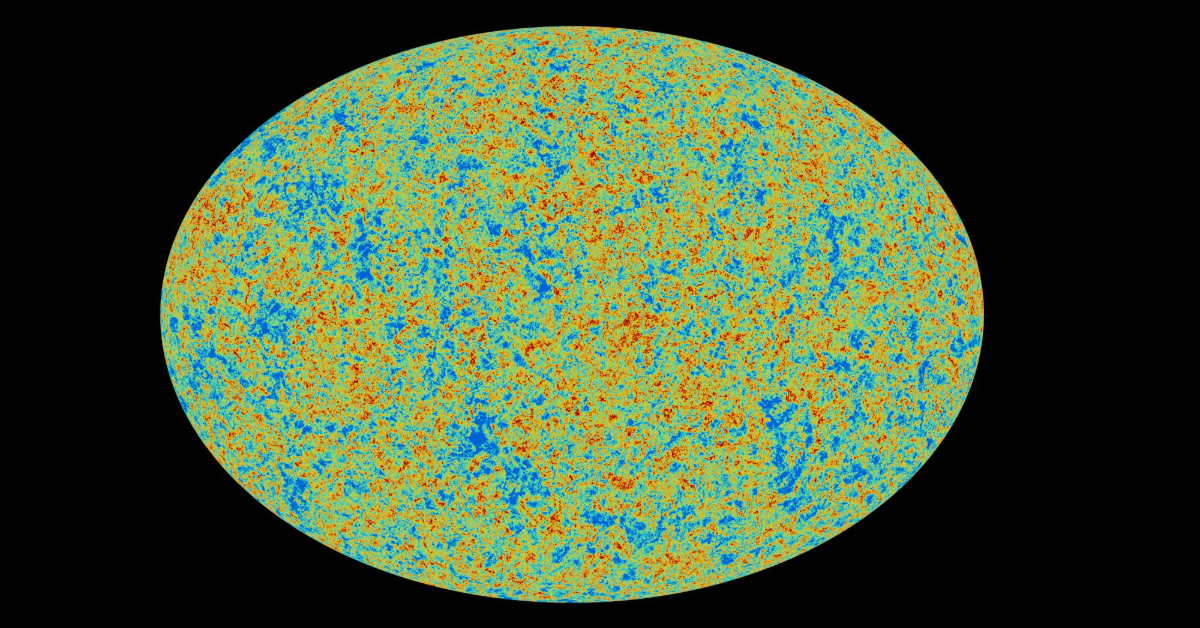
However, it has been observed that the CMB is not uniform in every direction; there are slight variations in temperature.
These differences are minute—roughly one part in 100,000 in early measurements. This is where things get truly interesting.
These slight variations are crucial because they reflect density differences in the early universe.
Over time, gravity amplified these small differences.
Some regions became denser, and matter accumulated there. Eventually, these regions helped form stars, galaxies, galaxy clusters, and the cosmic structures we see today.
How Was the CMB Discovered?
What is the Cosmic Microwave Background (CMB)? Beyond understanding what it is, it is also interesting to note that the CMB was discovered unexpectedly in the 1960s.
Penzias and Wilson
In 1964, radio astronomers Arno Penzias and Robert Wilson were working with a sensitive microwave antenna at Bell Laboratories.
They detected a persistent background signal that appeared to be coming from every direction.
Initially, they were unable to identify the source of this signal.
They investigated potential causes of interference, including equipment malfunctions and other unwanted effects.
Eventually, the scientists realised that it was not a local source of interference; the signal was originating from the universe itself.
This discovery by Penzias and Wilson provided concrete evidence for the early, hot universe.
In 1965, NASA recognised their finding as the discovery of the CMB.
This discovery remains a significant milestone in modern cosmology.
COBE, WMAP, and Planck: Mapping the CMB
What is the Cosmic Microwave Background? For scientists, the discovery of the CMB was merely the starting point. They sought to measure it with greater accuracy, leading to several missions, such as:
COBE
NASA’s Cosmic Background Explorer (COBE) satellite achieved significant success in measuring the CMB.
COBE detected minute temperature fluctuations across the sky.
These variations were crucial because they revealed that the early universe was not uniform or smooth.
WMAP
NASA’s Wilkinson Microwave Anisotropy Probe (WMAP) created a highly detailed map of the CMB.
WMAP measured subtle temperature differences across the sky and helped determine key characteristics of the universe—such as its age, composition, geometry, and structure.
Planck
ESA’s Planck mission created a highly detailed map of the CMB and helped refine our understanding of the universe’s fundamental parameters.
Collectively, these missions transformed the CMB from a mysterious background signal into a vital piece of evidence in the field of cosmology.

What Does the CMB Look Like?
What is the Cosmic Microwave Background (CMB)?
Along with the answer to this, the question arises: what does the CMB look like? According to scientists, you can visualise it by recalling those colourful, oval-shaped maps of the universe featuring red, yellow, green, and blue regions; if you have seen such an image, you have likely seen a visualisation of the CMB.
This does not mean that the CMB actually appears in these colours to the human eye.
Instead, scientists assign colours to slight variations in temperature and intensity so that they can visualise the data.
The CMB map displays radiation coming from various directions across the sky.
These minute variations form an intricate pattern.
Scientists can statistically analyse these patterns to derive information about:
- The density of matter
- The geometry of space
- The early universe
- The distribution of ordinary matter
- Dark matter
- Cosmic expansion
- The seeds of large-scale structures
In other words, the CMB map is not merely a beautiful image.
It is a scientific dataset containing information about the early universe
What Are CMB Temperature Fluctuations?
What is the cosmic microwave background? The CMB is remarkably uniform, but it’s not perfectly smooth.
Some regions are slightly hotter or cooler than the average temperature.
These fluctuations are called CMB inhomogeneities.
They may seem trivial, but they are actually one of the CMB’s most important features.
Think of it like small hills and valleys on a flat plain.
Over time, gravity causes matter to move toward denser regions.
The same basic principle applies to the early universe.
Small differences in density were the primary driver of the development of massive cosmic structures.
According to NASA, variations in the CMB’s temperature reflect differences in the density of the early universe, which ultimately contributed to the formation of stars and galaxies.
So, when scientists study these small fluctuations, they are studying the oldest known seeds of today’s cosmic structure.
For a deeper look at the Cosmic Microwave Background and how the Planck mission studied its tiny temperature variations, see the ESA Planck mission’s detailed explanation of the Cosmic Microwave Background.
Why Is the CMB Important?
What is the cosmic microwave background? The CMB provides direct observational evidence about the young universe. That’s why it’s so important.
It helps scientists test models of cosmic evolution instead of relying on mathematical predictions.
The CMB helps us answer the following questions:
- How old is the universe?
- What is the universe made of?
- What is the amount of dark matter?
- What is the amount of normal matter?
- What is the geometry of space?
- How did cosmic structures form?
- How did the early universe behave?
- What happened during the universe’s earliest observable stages?
The importance of the CMB is impossible to put into words.
It is one of the strongest observational pillars of modern cosmology.
What Does the CMB Tell Us About the Universe?
What is the cosmic microwave background? The cosmic microwave background connects the early universe to the universe we see today.
Age of the Universe
Measurements of the CMB help scientists estimate the age of the universe.
According to modern cosmology, the universe is 13.8 billion years old.
“Our blog gives you full details on the age of the universe.”
Dark Matter and Dark Energy
The CMB helps scientists understand the structure of the universe as a whole.
Measurements have shown that ordinary matter makes up only a small portion of the universe, while dark matter and dark energy dominate the cosmic energy budget.
According to NASA, the universe is composed of 5% ordinary matter, 27% dark matter, and 68% dark energy. However, the exact values depend on the cosmological model and dataset being discussed.
Explore the composition of the universe and how dark matter and dark energy affect it.
Galaxy formation
The CMB also helps us understand how the universe evolved from a nearly smooth initial state to the structured cosmos it is today.
Small fluctuations were amplified by gravity. Over billions of years, matter accumulated into ever more complex structures. Eventually, stars formed.
Then galaxies formed.
Galaxy clusters and the vast cosmic web formed.
“If you want to learn more about the scale of the cosmos, read our guide on how many galaxies are there in the universe and see how our own stellar neighbourhood fits in by exploring What the Milky Way Galaxy is “
Is the CMB the same everywhere?
What is the cosmic microwave background? Along with this question, the question also comes to mind: is the CMB the same everywhere—well, we could say almost, but not quite.
The CMB appears quite uniform across the sky.
However, very sensitive instruments can detect small variations.
These differences are called anisotropy.
These changes are so small that ordinary instruments cannot detect them.
Scientists need very sensitive space-based observatories and advanced data analysis.
The near-uniformity of the CMB is important in itself because it tells us that the early universe was fairly uniform on large scales.
Also, the small deviations from the uniformity provide important information for understanding how structure evolved.
This is a beautiful example of how something that appears almost perfectly smooth can contain a lot of information.
Can We See the CMB With Our Eyes?
No.
Human eyes cannot directly see the Cosmic Microwave Background (CMB).
The CMB is primarily detected in the microwave region of the electromagnetic spectrum, which is invisible to the human eye.
Specialised microwave detectors are required to measure it.
Think of it this way: humans cannot directly see radio waves, X-rays, or infrared radiation, even though these forms of electromagnetic radiation are real and can be measured.
Therefore, while the CMB surrounds us, we need scientific instruments to detect it.
CMB vs. Big Bang Radiation: What's the Difference?
These terms can sometimes be confusing.
The Big Bang theory describes the evolution of the universe from its extremely hot and dense initial state.
In contrast, the Cosmic Microwave Background (CMB) consists of radiation left over from that very beginning.
Therefore, the two concepts are not contradictory.
Rather:
The Big Bang describes the history of the universe.
The CMB serves as crucial evidence for that history.
The CMB does not show the universe’s very first moments.
Instead, it reveals the radiation emitted when the universe became transparent—an event that occurred approximately 380,000 years after the hot, initial expansion began.
According to NASA, the CMB originated about 380,000 years after the Big Bang and is a vital tool for understanding the early universe.
“To understand the origins of the cosmos, read our comprehensive guide on what the Big Bang Theory is and how the universe began.”
15 Amazing Facts About the Cosmic Microwave Background
Some points to remember are given below:
- CMB is the oldest light we can see directly.
- It was formed about 380,000 years after the Big Bang.
- Today, its average temperature is about 2.725 K.
- It is spread in every direction in the sky.
- CMB is observed mainly in the microwave spectrum.
- Its initial wavelengths were stretched as the universe expanded.
- Arno Penzias and Robert Wilson discovered this signal in the 1960s.
- COBE detected very small changes in the CMB.
- WMAP created a detailed map of the entire sky.
- Planck gave very accurate measurements of the CMB.
- Fluctuations in the CMB are very small.
- These fluctuations contain information about the early universe.
- CMB helps scientists study dark matter.
- Measurements of the CMB help in understanding the structure and composition of the universe.
- The CMB provides clues about how today’s galaxies and cosmic structures formed.
Frequently Asked Questions About the Cosmic Microwave Background
What is the cosmic microwave background in simple words?
The cosmic microwave background is the faint leftover glow from the early universe. It was released when the universe became transparent, roughly 380,000 years after the Big Bang.
Why is the CMB called microwave radiation?
The universe has expanded since the CMB was released. This expansion stretched the original light’s wavelengths, shifting it into the microwave part of the electromagnetic spectrum.
How old is the cosmic microwave background?
The CMB is about 13.8 billion years old, though the light was released about 380,000 years after the universe began.
What temperature is the CMB?
The average CMB temperature is about 2.725 kelvin, or roughly −270.4°C.
Who discovered the cosmic microwave background?
Arno Penzias and Robert Wilson discovered the unexplained microwave signal in the 1960s. Their discovery was later recognised as the cosmic microwave background.
Why is the CMB important?
The CMB provides a detailed record of conditions in the early universe. Its patterns help scientists study the universe’s composition, geometry, evolution, and the origins of large-scale structure.
Can we see the CMB from Earth?
Yes, but not with our eyes. Specialised instruments can detect the microwave radiation coming from every direction in the sky.
Does the CMB prove the Big Bang?
The CMB provides extremely strong observational support for the hot Big Bang model. Its measured properties closely match predictions for radiation released from a hot, dense early universe.
What are CMB fluctuations?
CMB fluctuations are tiny differences in temperature across the sky. They reflect differences in the density and conditions of the early universe and helped provide the seeds for later cosmic structure.
Is the CMB everywhere in the universe?
The CMB is observed across the sky in essentially every direction. It forms a pervasive background of ancient microwave radiation.
Conclusion
What is the Cosmic Microwave Background? It is the ancient glow of the early universe—a faint radiance that emerged approximately 380,000 years after the Big Bang and expanded along with the universe over billions of years.
A key feature of the CMB is that it reveals not only that the universe was once hot and dense, but also that the subtle variations within it help us understand how matter was distributed, how cosmic structures formed, and how the universe evolved into its current vast state.
If you’re curious to explore the science further, NASA’s https://science.nasa.gov/mission/wmap/wmap-overview/ provides additional background and mission information.
The CMB is the oldest message that scientists are still learning to decipher.
Pingback: What is the universe ? 8 mind-blowing facts -
Pingback: What is the universe made of? 7 fascinating truths -
Pingback: How Did the Universe Begin? 8 Amazing facts -
Pingback: How Old Is the Universe? 13.8 Billion-Years Mind-Blowing Cosmic History -
Pingback: How Big Is the Universe? 7 Powerful Facts -
Pingback: What Is the Observable Universe? 7 Mind-Blowing Facts -
Pingback: What Is the Big Bang Theory? 10 Fascinating Facts About the Universe’s Explosive Beginning -
Pingback: What Happened Before the Big Bang?11 Mind-Blowing Theories -
Pingback: Is the Universe Infinite? 15 Astonishing Facts About the Endless Cosmos -
Pingback: How Many Galaxies Are There in the Universe? 10 Incredible Facts You Need to Know -
Pingback: What Is Dark Matter? 7 Mind-Blowing Facts That Could Change Our Understanding of the Universe -
Pingback: What Is Dark Energy? 11 Amazing Facts About The Mysterious Force Expanding the Universe -