
Introduction
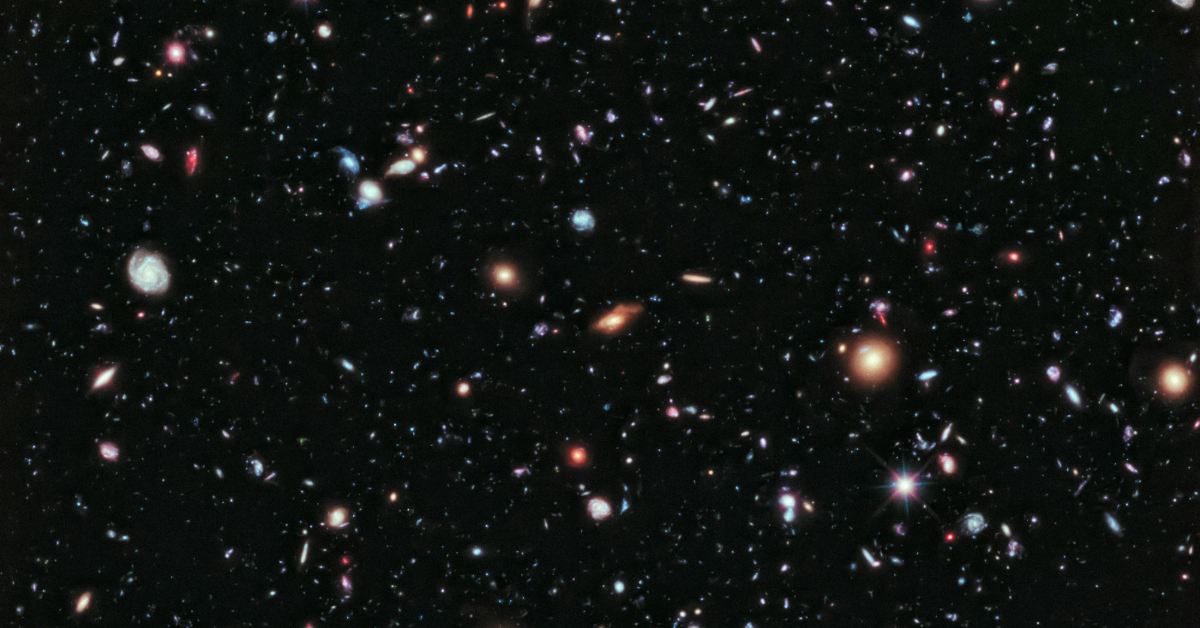
What is the observable universe? This question invariably sparks curiosity in the minds of those interested in science and space. To put it plainly, the observable universe is that which we can see and identify from Earth using light, radiation, and advanced technology.
However, this is not the entire cosmos; it is merely a segment—one that is limited by the distance light has traversed from the dawn of time up to the present moment.
Table of Contents
What Does “Observable Universe” Mean?
Definition in Simple Terms
“What is the observable universe?”—The straightforward answer to this question is that it is the segment of space visible to us from Earth. This includes galaxies such as the Milky Way and Andromeda, stars, planets, and cosmic radiation.
We can easily grasp this concept through an analogy: imagine standing in a darkened room with a flashlight; you can see only as far as the beam of light extends. Likewise, we can observe only those regions of the universe from which light has had sufficient time to reach us.
Why We Can’t See Everything
What is the observable universe? Along with understanding what the observable universe is, you might be wondering why we cannot see the entire universe. Two factors provide the answer to this question:
The age of the universe is approximately 13.8 billion years.
And the speed of light is finite.
Therefore, when light travels, it takes time—it requires a certain amount of time to traverse a specific distance. Consequently, anything existing beyond this distance has not yet reached us.
Size of the Observable Universe
Diameter and Radius Explained
What is the observable universe? The observable universe is that which is not merely vast but extends far beyond the very limits of our imagination. Its:
Radius: Approximately 46.5 billion light-years
Diameter: Approximately 93 billion light-years
Furthermore, while the age of the universe is approximately 13.8 billion years, the objects within it have travelled far greater distances due to the universe’s expansion.
Light Years and Cosmic Distances
A light-year is the distance light travels in one year:
- 1 light-year ≈ 9.46 trillion kilometres
Distances in space are so huge that kilometres just don’t cut it anymore!
How Scientists Measure the Observable Universe
Role of Light and Telescopes
Scientists mainly depend on light to gain knowledge about space.
These instruments are utilised to explore space, and they are as follows:
- Space telescopes
- Radio telescopes
- Infrared detectors
These instruments receive signals from distant objects, and scientists combine these signals to create a map of the observable universe.
Cosmic Microwave Background
One of the most crucial discoveries made by scientists is the Cosmic Microwave Background (CMB)—a faint snapshot of the universe from a time shortly after its beginning.
It serves as a “baby picture” of the cosmos, revealing how the universe appeared immediately after its origin.
By studying this ancient radiation, scientists can decode the blueprint of the early universe to answer our next big question: what exactly is the cosmic microwave background?
Structure of the Observable Universe
Galaxies and Clusters
The observable universe comprises the following:
- Billions of galaxies
- Each galaxy contains billions of stars
Galaxies cluster together in groups and superclusters.
Cosmic Web
Observing the universe on a large scale reveals a structure resembling a vast web:
- Filaments of galaxies
- Vast empty regions, known as ‘Voids’
This structure is known as the Cosmic Web. It is a remarkable pattern that spans the entire universe.
Observable Universe vs Entire Universe
Key Differences
Observable Universe | Entire Universe |
What we can see | Everything that exists |
Limited by light | Possibly infinite |
Measurable | Unknown size |
Is the Universe Infinite?
Scientists aren’t fully sure. Some theories suggest:
- The universe could be infinite
- Or it might be finite but unbounded
In simple words, it might go on forever—or loop back on itself.
Expansion of the Observable Universe
Big Bang Connection
According to scientists, the universe began with the ‘Big Bang’—an event that marked the inception of everything. Since that time, space itself has been continuously expanding.
Accelerating Expansion
Now, this becomes even more fascinating:
- The universe is not merely expanding;
- Rather, it is expanding at an accelerating rate over time.
Scientists believe that this is happening because of dark energy.
Why There Is a Limit to What We Can Observe
Speed of Light Limitation
We know that nothing can travel faster than the speed of light. This is a law of science.
For this very reason:
- We can only see those objects whose light has reached us.
- Anything beyond this remains invisible.
Cosmic Horizon
The Cosmic Horizon is the limit of our universe—the farthest extent to which we can see.
We cannot see beyond this boundary—at least, not yet.
Fascinating Facts About the Observable Universe
Here are some interesting facts:
- It contains over 2 trillion galaxies
- Most of the universe is made of dark matter and dark energy
- Only about 5% is normal matter and energy
- The farthest light we see is from the early universe
- Space is still expanding right now
If you want to get some more information, please go to our blog post “What is space made of?” on aerospace1st.com
Importance of Studying the Observable Universe
Understanding the observable universe helps us:
- Learn about the origin of everything
- Predict the future of the cosmos
- Discover new physics and technologies
Future Discoveries and Technologies
Upcoming advancements include:
- More powerful telescopes
- Better space missions
- Advanced AI analysis
These tools may allow us to:
- See deeper into space
- Discover new galaxies
- Understand dark matter and dark energy
Frequently Asked Questions (FAQ)
What is the observable universe in simple words?
It is the part of the universe we can see from Earth using light and technology.
How big is the observable universe?
It is about 93 billion light-years in diameter.
Why can’t we see the entire universe?
Because light from distant regions hasn’t reached us yet.
Is the observable universe expanding?
Yes, it is continuously expanding over time.
What lies beyond the observable universe?
We don’t know for sure—it could be more universe or something entirely different.
How old is the observable universe?
It is about 13.8 billion years old.
Conclusion
What is the observable universe? It is that part of the cosmos which we are able to see. It is an incredibly vast, continuously expanding region, teeming with galaxies, stars, and countless mysteries.
Although it possesses certain limits, it nonetheless contains far more phenomena than currently lie within the scope of our understanding. And as technology continues to evolve, our comprehension will expand even further.
In the end, this observable universe points to a profound truth:
We have only just begun our journey to understand the universe.
For more knowledge, visit https://www.nasa.gov/