
Introduction
How did the universe begin? This question has intrigued and puzzled us all from ancient times. We, humans, have always tried to understand where it all came from. From ancient stories to modern physics, this effort has been made. Today, we humans are using powerful telescopes, particle accelerators, and advanced mathematics to piece together these stories.
Understanding the beginning of the universe isn’t just about satisfying our curiosity, but also about answering profound questions that have lingered since time immemorial. Why do physical laws exist? How did galaxies form? How did stars form? And finally, what is our place in the universe?
While modern cosmology—the science of the universe—has not completely solved every mystery, we now have better information backed by more evidence than ever before. This gives us a clearer picture of the universe.
Table of Contents
Why Humans Ask How Did the Universe Begin
How did the universe begin? This question always arises in humans because of their natural inquisitive nature. When we look up at the sky in the dark of night, we don’t just see stars, but a story waiting to be told. And this curiosity fuels science, philosophy, and the arts.
There are three main reasons why this question is important:
- Identity: Knowing our cosmic origins helps us understand ourselves.
- Science: It explains how physical laws work.
- Future: It guides predictions about the fate of the universe.
Origin stories existed in every culture long before modern science. Today, we rely on institutions like NASA to provide evidence of the universe’s origins, abandoning myths and studying the cosmos using cutting-edge technology.
The Big Bang Theory Explained Simply
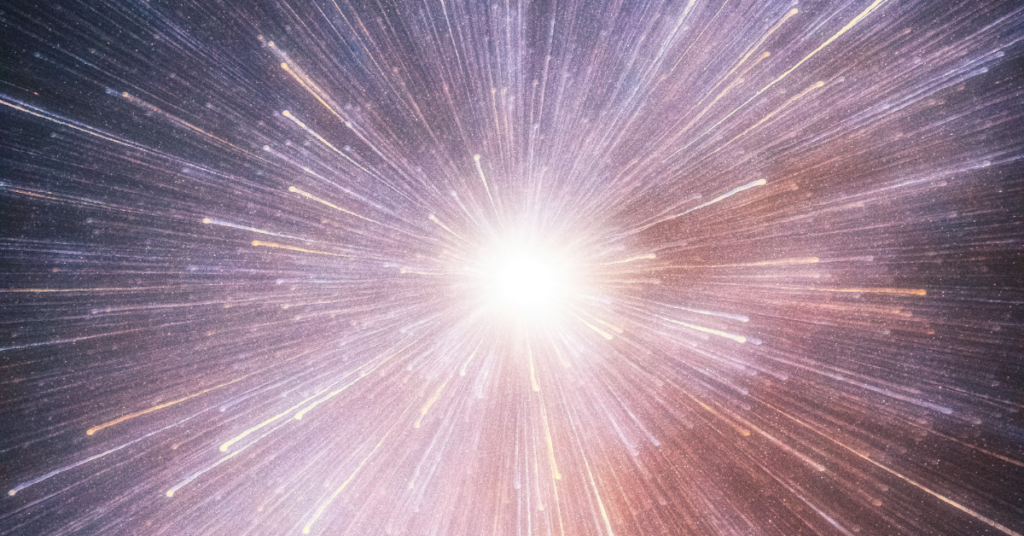
How did the universe begin? A theory answers this question, and we call it the Big Bang Theory. This theory tells us that the universe began from an infinitely small, dense, and hot point about 13.8 billion years ago.
This wasn’t an explosion in space; it was the expansion of the universe, and it continues to expand. We can think of it like making dots on a balloon and then inflating it; each dot moves further apart. Similarly, as space expands, galaxies move further apart.
Scientist Albert Einstein laid the foundation of relativity and said that time and space are connected and dynamic.
What Existed Before the Big Bang
Current physics cannot accurately describe the initial time of the Big Bang. Some ideas have been proposed, including the following:
- A quantum fluctuation
- A previous universe collapsing
- Timeless quantum state
In Simple terms, we’re not sure yet
Evidence Supporting the Big Bang
The Big Bang Theory isn’t just a guess. Evidence has been observed to support it.
- High abundance of light elements like hydrogen and helium
- Expanding galaxies
- Cosmic microwave background radiation
The Hubble Space Telescope has observed the cosmic microwave background radiation in detail, supporting the Big Bang.
“Out of all these clues, the cosmic microwave background is the ultimate proof—it is basically the leftover heat from the Big Bang that we can still see today.”
The First Seconds After Creation
Fundamental forces and particles emerged within the first fraction of a second of the universe’s formation.
Formation of Fundamental Forces
Initially, all forces may have been unified. As the universe cooled, four types of forces came into the universe
- Gravity
- Electromagnetism
- Strong nuclear force
- Weak nuclear force
These forces shaped how matter interacts today.
Birth of Matter
How did the universe begin? As the infinitely small, hot, and dense point expanded, all the pure energy converted into particles. Particles like quarks combine to form protons and neutrons. A few minutes later, hydrogen and helium nuclei formed. These types of simple elements became the building blocks of stars.
Formation of Stars and Galaxies
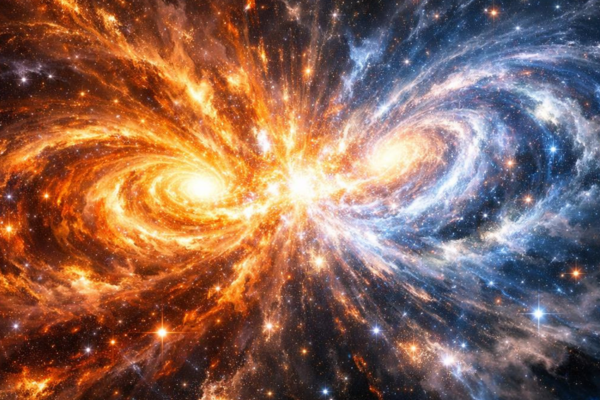
The Gravitational collapse of gas and dust particles creates molecules. The dense region of molecular clouds collapses to form a star. Inside the star, nuclear fusion occurs, creating heavy elements like carbon and oxygen—essential for life.
On a larger scale, gravity pulls gas and dark matter together to form galaxies.
How Gravity Shaped the Universe
Gravity acts like the creator of the universe. It:
- Creates galaxies
- Controls the orbits of stars and planets
- Affects the structure of the universe.
Without gravity, matter would remain spread out, and there would be no stars or planets.
The Role of Cosmic Background Radiation
Microwave radiation spreading through space is one of the most unique discoveries for scientists. Here’s an early glimpse of the universe after its formation.
This radiation helps scientists measure:
- The age of the universe
- The rate of expansion of the universe
- Variations in the initial density
These small changes eventually formed galaxies and galaxy clusters.
Modern Discoveries About the Universe’s Beginning
The technology that scientists have pioneered in recent times has transformed the way we view the universe. Telescopes like the James Webb are one of the most remarkable technologies scientists have ever had, allowing them to see deeper into the universe and further back in time.
Scientists now study:
- Early galaxy formation
- Dark matter distribution
- Cosmic inflation signatures- rapid exponential expansion of the universe
These discoveries tell us how the universe began and what happened afterwards.
Contributions of Space Telescopes
How did the Universe begin? Telescopes have made a significant contribution to understanding the beginning of the Universe because they are not affected by atmospheric distortion.
Hubble Space Telescope- These Telescopic observations have revealed that galaxies formed surprisingly early. These galaxies were smaller and more irregular than today’s galaxies.
James Webb Telescope- This telescope can look further back. This telescope uses infrared technology to discover the earliest formed stars and galaxies, which lie outside the visible light spectrum.
Alternative Theories About the Beginning
How did the universe begin? The Big Bang Theory provides the base to know about the beginning of the universe. In addition to the Big Bang, scientists are also working on other theories, such as:
- Cyclic Universe: Cycles of expansion and contraction
- Multiverse: Multiple universes exist
- Quantum Creation Model
These ideas are still speculative, but they help science develop.
What is the Future of Cosmology
How did the universe begin? As we gain more information about the universe’s origin and evolution, future missions will aim to measure the universe’s gravitational waves and explore its energy in greater depth.
If we succeed, we could answer these questions:
- What caused cosmic inflation?
- Did time have a beginning?
- Do other universes exist?
Key Takeaways
- The universe began about 13.8 billion years ago
- The Big Bang is supported by strong evidence
- Stars created the elements needed for life
- Modern telescopes continue to refine our understanding
- Many mysteries remain
Frequently asked questions
1. What is the Big Bang in simple terms?
This describes the origin of the universe from a hot, dense state to its rapid expansion.
2. How do scientists know the universe is expanding?
They observe galaxies moving away from us through redshift measurements.
3. Did time exist before the universe began?
Current theories suggest time started with the universe, but this isn’t fully confirmed.
4. How old is the universe?
Approximately 13.8 billion years based on multiple measurements.
5. Could there be multiple universes?
Some theories suggest a multiverse, but there’s no direct evidence yet.
6. Why is cosmic background radiation important?
It provides a snapshot of the early universe, confirming Big Bang predictions.
Conclusion
How did the universe begin? Knowing how the universe began will be one of humanity’s greatest triumphs. Through observations, theories, and a persistent desire to learn, we’ve progressed from myth to measurable evidence.
The journey isn’t over; every piece of information raises new questions. What tells us that the universe is vast is deeply fascinating. As technology advances, we may one day discover just how much bigger it is than we imagined.
For more information https://www.nasa.gov/
Pingback: What Is the Cosmic Microwave Background? 15 Amazing Facts About the Universe’s Oldest Light -
Pingback: What Is Space Made Of? 13 Astonishing Components That Fill the Vast Cosmos -